

1. Methodology background
| National Statistic |  |
| Survey name | Workforce Jobs QMI |
| Frequency | Quarterly |
| How compiled | Sample based surveys |
| Geographic coverage | UK |
| Sample size | 83,400 |
| Last revised | 5 March 2013 |
2. Overview
- measures the number of jobs in the UK
- sample size of 83,400 (short term employer surveys (STES) 32,800 businesses, the quarterly public sector employment survey (QPSES) 1,500 contributors and the labour force survey (LFS) 50,000 households)
- estimates are seasonally adjusted
- time series data are available from 1959
Workforce jobs is a quarterly measure of jobs in the UK, and is the preferred measure of short term employment change by industry. A variety of outputs are produced, including industry, region, gender and full or part time status.
The number of jobs measured are the sum of employee jobs, self-employment jobs, government supported trainees and Her Majesty’s Forces.
The estimates are compiled from a number of sources, including Short Term Employer Surveys (STES), the Quarterly Public Sector Employment Survey (QPSES) and the Labour Force Survey (LFS).
Workforce jobs estimates are published in the Labour Market statistical bulletin.
The data are used across government to facilitate policy making, business and academia, with the main users being HM Treasury (HMT), the Bank of England, the Department for Education and Eurostat.
Nôl i'r tabl cynnwys3. Executive summary
A fundamental redevelopment of WFJ sources, classifications, methods and systems was undertaken in 2010. An article explaining the redevelopment in full was published as part of the September 2010 Economic and Labour Market Review (ELMR).
Workforce jobs estimates are published in the Labour market statistical bulletin. This report contains the following sections:
- Output quality
- About the output
- How the output is created
- Validation and quality assurance
- Concepts and definitions
- Other information, relating to quality trade-offs and user needs
- Sources for further information or advice
4. Output quality
This report provides a range of information that describes the quality of the output and details any points that should be noted when using the output.
We have developed Guidelines for Measuring Statistical Quality; these are based upon the five European Statistical System (ESS) quality dimensions. This report addresses the quality dimensions and important quality characteristics, which are:
- relevance
- timeliness and punctuality
- comparability
- coherence
- accuracy
- output quality trade-offs
- assessment of user needs and perceptions
- accessibility and clarity
More information is provided about these quality dimensions in the following sections.
Nôl i'r tabl cynnwys5. About the output
Relevance
(The degree to which the statistical outputs meet users’ needs.)
Table 1 contains summary information about Workforce jobs (WFJ) and its three main sources, namely:
- Short-Term Employer Surveys (STES), which measures private sector employee jobs (EJ)
- Quarterly Public Sector Employment Survey (QPSES), which measures public sector EJ
- Labour Force Survey (LFS) from which series for self-employment jobs (SEJ) are obtained
Further detail on these and other WFJ sources is available in this report. Separate Quality and Methodology Information (QMI) reports for public sector employment and LFS are also available.
Table 1: Workforce jobs estimates and its main sources
| What it measures | The number of jobs in the United Kingdom. |
|---|---|
| Frequency | Estimates of WFJ are produced on a quarterly basis. |
| Sample size | Approximate number of respondents per quarter: |
| · STES –: 32,800 businesses, | |
| · QPSES –: 1,500 contributors, | |
| · LFS: – 50,000 households. | |
| Periods available | Time series are available back to 1959. |
| Sample frame | STES and, QPSES: Inter-Departmental Business Register (IDBR). LFS: Postcode Address File and NHS communal accommodation. |
| Sample design | STES: Stratified random sampling by industry and employment, with 100% coverage of businesses with register employment above a threshold which that varies by industry. |
| QPSES: Census. | |
| LFS: Stratified random sample of addresses where all people aged 16 and over+ are interviewed. Each quarter’s sample is made up of five waves. Respondents are interviewed for five successive waves at three3-monthly intervals. | |
| Approximately 20% of the sample is replaced every quarter. | |
| Weighting and estimation | STES: In strata without 100% coverage, by calibration to register employment totals (industry sector by region). Each business represents a number of similar businesses, based on the number of employees and the UK Standard Industrial Classification 2007 (SIC 2007). |
| QPSES: No weighting required. | |
| LFS: Calibration weighting is used. The weights are formed using a population weighting procedure, which involves weighting data to sub- regional population estimates and then adjusting for the estimated age and sex composition by region. | |
| Imputation | STES and, QPSES: Estimates for non-response are made using standard imputation techniques employed by ONS business surveys. |
| LFS: Roll-forward (for one wave only). | |
| Outliers | STES: Outliers are detected via automated and manual processes and are treated by adjusting their estimation weights. |
| QPSES and, LFS: No filtering of outliers. | |
| Seasonal adjustment | The series are seasonally adjusted in X12 ARIMA. |
| Source:Office for National Statistics | |
Download this table Table 1: Workforce jobs estimates and its main sources
.xls (30.2 kB)Workforce Jobs estimates are published on a quarterly basis at different levels depending on the medium of release. Estimates of WFJ are available for the UK and Great Britain and are produced at a regional level using the Nomenclature of Units for Territorial Statistics (NUTS1).
Users and uses
Workforce Jobs estimates and data produced for the quarterly publication are used across government, business and academia, and feed into a number of wider publications and outputs. Some government departments use the total figures to facilitate policy-making, whereas others use specific components of the published data.
Some of the main users are:
- HM Treasury – WFJ estimates are used to assess labour market conditions and are an important indicator in the context of macroeconomic assessment
- Bank of England (BoE) – the BoE Monetary Policy Committee is a user of WFJ estimates and the BoE use the WFJ estimates as an indicator for setting interest rates
- Department for Education (DfE) – DfE use WFJ to inform and monitor policy-making such as the success of their Welfare to Work programme
- Eurostat – estimates of EJ are supplied directly to Eurostat; this is a legal requirement under the Short-Term Indicators Regulation (STIR)
- devolved administrations – Scottish and Welsh Governments
Strengths and limitations
The WFJ series is designed to be comparable over its whole duration, and this, together with the accuracy of its industrial information, is its major strength. However, the series cannot provide detailed industrial breakdowns (for example, 4 digit SIC 2007), which are best sourced from the Business Register and Employment Survey (BRES). There is also no information available for geographies smaller than NUTS1 regions. Additionally, since WFJ is reliant on inputs from multiple sources, issues such as discontinuities in source data can affect the quality of final outputs (see the “Comparability and coherence” section for more information).
Timeliness and punctuality
(Timeliness refers to the lapse of time between publication and the period to which the data refer. Punctuality refers to the gap between planned and actual publication dates.)
The time lag between publication and the reference period is 11 to 12 weeks.
Each quarter, any revisions to the previous quarter’s data are published. All quarterly figures are reviewed annually at Quarter 3 (July to Sept) and revised if necessary.
For more details on related releases, the release calendar is available online and provides 12 months’ advance notice of release dates. If there are any changes to the pre-announced release schedule, public attention will be drawn to the change and the reasons for the change will be explained fully at the same time, as set out in the Code of Practice for Official Statistics.
Nôl i'r tabl cynnwys6. How the output is created
Overview
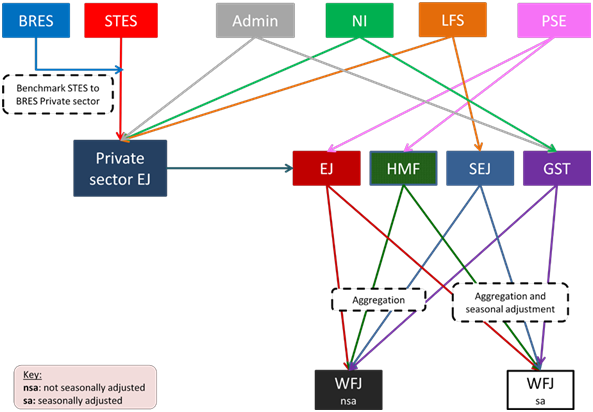
Workforce jobs (WFJ) draws on a range of sources and is the sum of employee jobs (EJ) measured primarily by employer surveys, self-employment jobs (SEJ) from the Labour Force Survey (LFS) and government-supported trainees (GST) and Her Majesty’s Forces (HMF) from administrative sources.
Please see Figure 1 for more information on the flow of data from inputs to final WFJ aggregates.
Short-Term Employment Surveys
Employee jobs (EJ) is by far the largest component of WFJ. Most of the EJ comes from Short-Term Employment Surveys (STES), a group of surveys that collect employment and turnover information from private sector businesses in Great Britain. Another notable input to EJ is from our public sector employment estimates (PSE). Table 2 provides more information on STES.
Table 2: A summary of the Short-Term Employment Survey
| Survey | Variables size | Sample | |||||
|---|---|---|---|---|---|---|---|
| Monthly Business | Monthly turnover and quarterly | 30,000 turnover. | |||||
| Survey (MBS) | employment. | 17,800 employment sub-sample | |||||
| Quarterly Business | Quarterly employment only. | 4,600.00 | |||||
| Survey (QBS) | |||||||
| Retail Sales Index | Monthly turnover and quarterly | 5,000 turnover. | |||||
| (RSI) | employment. | 2,400 employment sub-sample. | |||||
| Construction | Monthly output and quarterly | 8000 | |||||
| employment. | |||||||
| Total employment sample: | 32,800 in quarter months. | ||||||
| 0 in non-quarter months. | |||||||
| 131,200 annual total | |||||||
| Source: Office for National Statistics | |||||||
Download this table Table 2: A summary of the Short-Term Employment Survey
.xls (21.0 kB)The next section, as far as “STES estimation and calibration”, refers uniquely to STES.
STES coverage
Estimates cover Great Britain businesses registered for Value Added Tax (VAT) and/or Pay-As-You-Earn (PAYE) and are classified to the Standard Industrial Classification 2007 (SIC 2007). It covers all major industry groups, such as production, construction, distribution, service trades and many more groups in SIC 2007.
The required details on these businesses are obtained from the Inter-Departmental Business Register (IDBR), which is then used as the survey sampling frame. The sample does not cover agriculture.
STES sample design
Businesses are sampled from the IDBR on a reporting unit (RU) basis. The IDBR stores details of approximately 2 million businesses registered in the UK and is maintained largely by updates from HM Revenue and Customs, Companies House and surveys conducted by Office for National Statistics (ONS) specifically geared to maintaining the Register. An RU is a register construct; larger enterprises are often split into a number of RUs that report for different local units (LUs). For example, an enterprise might have RUs for different regions or activities, each reporting for the LUs, such as retail outlets or factories, in their region or activity.
Short-Term Employer Surveys are comprised of about 32,800 RUs from across the Great Britain economy. A stratified random sample is drawn from the IDBR with strata being defined by SIC 2007 and employment size. All RUs with registered employment above a given threshold (which varies by industry) are included in the sample. Strata containing these RUs are referred to as fully-enumerated.
The design is similar to a stratified one-stage cluster sample, where the stage 1 units (or clusters) are RUs and the elements in each cluster are LUs. The returned employment data (or imputed data for non-responders) for the sampled RUs are apportioned between their LUs using the ratio of LU to RU employment from the IDBR. This process produces more refined employment estimates by region and by industry. See the “STES estimation and calibration” heading for further details.
STES outlier treatment
The treatment of outliers is applied at RU level. Outliers are detected via an automated process and are treated by adjusting their estimation weights. Further manual checks are also carried out and outliered businesses from previous periods are monitored.
STES imputation
Values for businesses that do not respond are imputed. Imputation is based on the pattern of responses for similar businesses. A link factor is calculated from responses received and applied to previous returns for each non-responder. The original construction for a never-responding business is calculated from a ratio (generated from other respondent values in the same strata) being applied to the register employment. For subsequent periods, imputed values will be based on movements in similar-sized businesses.
STES estimation and calibration
A generalised regression estimator is used with calibration to industry sections by region. This is explained more fully in the remainder of this section.
As it is not possible to survey every business in the population, it is necessary to weight the sample data to provide estimates for the full population. Apportioned RU returns (see “STES sample design” section) are weighted to represent non-sampled units. Since STES is not stratified by region (only by industry and size of business), weights are generated using a model which ensures that estimates are calibrated to LU employment totals of “regional industries” from the IDBR. Weighted LUs are then summed by region and industry to produce published level aggregates.
The estimator for a given domain d is defined using the following equation:

Where h denotes a stratum, H is the set of all strata, ah is the design weight, yi is the survey response for reporting unit i, oi is the outlier weight for reporting unit i, ri,d is the "region weight" for reporting unit i, gi is the calibration factor or g-weight for unit i and sh is the sample set in stratum h.



The values of ah and gi can be calculated using the following equations
Where Nh is the population count in stratum h, nh is the sample size in stratum h, xj is the IDBR employment value (or auxiliary value) for local unit j, aj is the design weight for the reporting unit to which local unit j belongs, Sc is the set of local units within the sample in the “regional industry” to which to which local unit j belongs and, Uc is the set of local units within the population in the “regional industry” to which to which local unit j belongs.
The g-weight is a sample dependent weight for each local unit. These weights ensure that the weighted totals of the auxiliary variable sum to the known population totals of industry (sections) by region from the IDBR.
The definition of rid is as follows:
Where xj is the IDBR employment value (or auxiliary value) for local unit j in reporting unit i, and 1jis is an indicator variable with value one if local unit j is in the domain d, and zero otherwise.
Inputs from public sector employment
Our public sector employment (PSE) estimates are the definitive source for public sector employment. The PSE sources form a quarterly census of the public sector as defined by the UK National Accounts. PSE series are produced with a detailed breakdown by industry (SIC 2007) and region from Quarter 1 (Jan to Mar) 2008. This has enabled PSE to be used as the source for Great Britain public sector EJ for most industries within WFJ from Quarter 4 (Oct to Dec) 2008 onwards.
Inputs from the Labour Force Survey
The LFS provides WFJ with SEJ series, the industry breakdown for the GST series and EJ series for agriculture.
Her Majesty’s Forces
Her Majesty’s Forces data are now provided directly from the PSE dataset described in this section. HMF data are supplied to ONS by Defence Analytical Services and Advice (DASA). The HMF series now supply WFJ by region from Quarter 1 1996, enabling regional WFJ series to be produced. Previously, the WFJ series excluded HMF and were termed Civilian WFJ. HMF based overseas are included in the regional UK estimates and so the sum of the regional WFJ estimates is slightly less than the UK WFJ.
Government-supported trainees
Government-supported trainees (GST) series are provided by the Department for Business, Innovation and Skills (BIS), the Welsh Assembly Government, the Scottish Government and Department for Enterprise, Trade and Investment Northern Ireland (DETINI). This covers employees without a contract. Those with a contract are collected as part of EJ.
Northern Ireland (NI)
Department for Enterprise, Trade and Investment Northern Ireland provide EJ, SEJ and GSTs for Northern Ireland on a quarterly basis.
Other administrative sources
The Civil Aviation Authority (CAA) provides ONS with the number of employee jobs (Great Britain) for the Air Transport industry.
Seasonal adjustment
Seasonal adjustment is the process of identifying and removing the seasonal components from a series to leave the underlying trend and irregular components. The system seasonally adjusts WFJ components by industry sections by regions and then aggregates the series through these three hierarchical dimensions. This bottom-up approach maintains additivity throughout the seasonally adjusted dataset without the need for constraining. It also enables the regional statistical bulletin tables to be produced with the same breakdowns and layouts as the national.
Seasonal effects are detected and treated using the X-12-ARIMA software package. The seasonal adjustment of WFJ was last reviewed by ONS methodology division in February 2013.
Workforce jobs flow
Figure 1: Flow of data from inputs to final workforce jobs aggregates
Source: Office for National Statistics
Download this image Figure 1: Flow of data from inputs to final workforce jobs aggregates
.png (78.6 kB)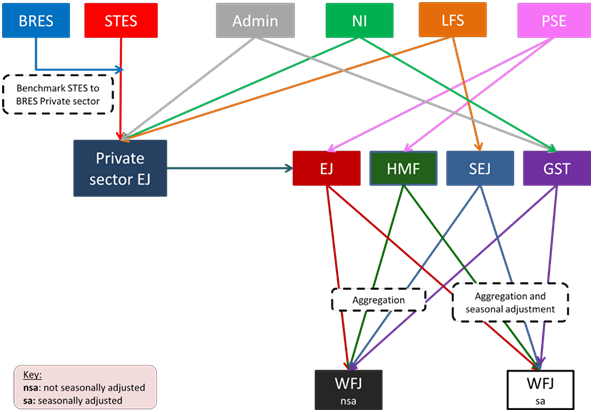
Statistical disclosure control
Statistical disclosure control methodology is applied to WFJ data. This ensures that information attributable to an individual or individual organisation is not identifiable in any published outputs. The Code of Practice for Official Statistics, and specifically the Principle on Confidentiality, sets out practices for how we protect data from being disclosed. The Principle includes the statement that ONS outputs should “ensure that official statistics do not reveal the identity of an individual or organisation, or any private information relating to them, taking into account other relevant sources of information”. More information can be found on the statistical disclosure control methodology page.
Nôl i'r tabl cynnwys7. Validation and quality assurance
Accuracy
(The degree of closeness between an estimate and the true value.)
Sampling error
Workforce jobs (WFJ) estimates are mainly based on statistical samples and as such are subject to sampling error. Historically, this has not been measured, due to the various complexities of WFJ. However, work has recently been undertaken to produce approximate confidence intervals by region and industry section, which we now publish on an annual basis (as of February 2013).
Non-sampling error
Non-sampling error is the error attributable to all sources other than sampling. It includes frame error such as under-coverage, treatment of non-response and outliers, measurement error and processing error.
Response rates are monitored closely on a quarterly basis by the survey team. Furthermore, each survey has a list of critical respondents (usually those with the largest employment) where special efforts are made to achieve 100% response and clearance of test failures.
Errors and revisions
In the event of a large error being detected with the data, all outputs and datasets will be revised in line with the Code of Practice for Official Statistics. More information on revisions can be found in our revisions policies and our Guide to statistical revisions. Reliance on surveys to collect information with which to produce statistics means that events and economic trends cannot be measured in their entirety. As more information becomes available over time, estimates can be revised to improve quality and accuracy, which provides a better picture of what is being measured. A policy of accepting revisions improves the accuracy of the data as other information becomes available. Revisions are therefore standard practice when producing official statistics.
In the case of WFJ, revisions are made to estimates for the previous period on a quarterly basis. Further to this, each year, revisions are made to the previous 2 years’ WFJ estimates to align the short-term employee jobs series to the latest estimates from the Business Register and Employment Survey (BRES) (please see the “Comparability and coherence” section for more details).
Comparability and coherence
(Comparability is the degree to which data can be compared over time and domain e.g. geographic level. Coherence is the degree to which data that are derived from different sources or methods, but refer to the same topic, are similar.)
WFJ estimates cover the whole UK economy as classified by industry using Standard Industrial Classification 2007 (SIC 2007). When methodological changes or other effects such as benchmarking are made to the latest data, every effort is made to ensure the series is comparable over time. A comparable back series is available back to 1959 for annual estimates and 1978 for quarterly estimates.
Benchmarking
In December of each year, revisions are made to WFJ estimates for the previous 2 years to “benchmark” the short-term employee jobs series to the latest estimates from BRES (prior to 2008, the Annual Business Inquiry (ABI) was used to “benchmark”).
Benchmarking is an annual process to align the quarterly Great Britain employee jobs (EJ) series to the latest estimates from BRES, a much larger sample than the Short-Term Employment Survey (STES) (approximately 80,000 contributors), which generally produces more accurate and detailed estimates. Estimates for BRES (previously ABI) refer to Quarter 4 (Oct to Dec) in each year up to 2005 and Quarter 3 (July to Sept) in subsequent years.
Discontinuities in the data
As part of the redevelopment of WFJ, we took the opportunity to replace the previously used matched-pairs estimator (which meant that only those businesses that were sampled for successive periods were used as part of the derived estimate) with a point-in-time estimator, our standard method. This change has served to remove the bias caused by the matched-pairs method.
The matched-pairs method tended to underestimate the change over time, as it excluded the creation and closure of businesses in the sample. In essence, only those businesses sampled in two consecutive periods were used to produce estimates of change. This bias caused large revisions when the STES series were benchmarked retrospectively to ABI (now BRES) estimates.
BRES selects a larger sample and also uses a point-in-time generalised regression estimator. The new estimator includes all sampled businesses in each and every period, which reduces the bias over time. The trade-off is an increase in volatility caused by the inclusion of the rotated part of the sample for small and medium-sized businesses. Sample rotation spreads the administrative burden, ensuring that businesses are selected for a limited number of periods. The change was introduced in 2010 and worked back to Quarter 4 2008 producing a visible increase in volatility for some lower-level WFJ series from this point. The redesign of STES, which incorporated the transition to SIC 2007, has further increased the volatility of some of these series between Quarter 4 2009 and Quarter 1 (Jan to Mar) 2010. See the Economic and Labour Market Review, September 2010 for further information.
In the majority of cases, discontinuities in source data (for example, the transition from ABI/1 to BRES in 2008) are smoothed, so that WFJ estimates closer reflect the true number of jobs in any given period and form more meaningful time series.
Employment versus jobs
The concept of employment (measured by the Labour Force Survey (LFS) as the number of people working at least 1 hour during the survey reference week) differs from the concept of jobs, since a person can have more than one job, and some jobs may be shared by more than one person. The LFS, which collects information mainly from residents of private households, is the preferred source of statistics on employment.
The LFS can also be used to produce estimates of the total number of jobs in the UK, by adding together the headline employment figures (which are equivalent to main jobs) and those for workers with a second job. However, the WFJ series, which is compiled mainly from surveys of businesses, is the preferred source of statistics on jobs by industry, since it provides a much more reliable industry breakdown than the LFS.
The Review of Employment and Jobs Statistics identified approximately 30 reasons why the LFS and WFJ estimates of jobs differ from each other. Some of these factors can be quantified using information from the LFS and other sources, while others are much more difficult to measure.
The approximate sampling variability of the difference between the adjusted LFS and WFJ estimates (95% confidence interval) is roughly plus or minus 250,000 to plus or minus 350,000. However, it should be noted that the adjustments are themselves subject to a margin of uncertainty and there are other factors causing differences between the two sources that have not been adjusted for. There are approximately 20 additional factors that could explain the remaining difference between the LFS and WFJ estimates. These are described in the final report of the review. As well as sampling variability, they include, for example, timing effects. The LFS estimates are averages for 3-month periods, whereas business surveys measure the number of jobs on a particular day. A reconciliation exercise is carried out each quarter to reconcile latest estimates.
Nôl i'r tabl cynnwys8. Concepts and definitions
(Concepts and definitions describe the legislation governing the output, and a description of the classifications used in the output.)
The definition of an employee is anyone working on a specific reference date who is aged 16 years and over, that the contributor directly pays from its payroll(s), in return for carrying out a full-time or part-time job or being on a training scheme. Part-time workers are classed as those who work 30 hours per week or less.
This includes:
- all workers paid directly from the business's payroll(s)
- those temporarily absent but still being paid, for example, on maternity leave
- employees at sites where the planned activity is for less than 1 year
- employees at sites manned for less than 20 hours per week
This excludes:
- any agency workers paid directly from the agency payroll
- voluntary workers
- former employees only receiving a pension
- self-employed workers (not paid via the business's payroll(s))
- working owners who are not paid via Pay-As-You-Earn (PAYE).
Estimates of employee jobs (EJ) are supplied directly to Eurostat. This is a legal requirement under the Short-term Statistics (STS) and European System of Accounts 2010 (ESA 2010) regulations.
Nôl i'r tabl cynnwys9. Other information
Output quality trade-offs
(Trade-offs are the extent to which different dimensions of quality are balanced against each other.)
Since workforce jobs (WFJ) is a short-term indicator, it is critical that outputs are timely. This means that estimates for the latest quarter will be less reliable than subsequent revised versions due to the inclusion of late returns from sampled businesses.
Assessment of user needs and perceptions
(The processes for finding out about users and uses, and their views on the statistical products.)
Workforce jobs seeks to obtain user views and uses via:
- consultation exercises; for example, during the redevelopment of Workforce Jobs in 2010, a consultation exercise was undertaken inviting users of quarterly employment estimates to provide their views and comments, shaping the outputs catalogue
- ad hoc meetings with Welsh Government and Scottish Government
- feedback from users on an on-going basis
- triennial and quinquennial reviews of the sources and surveys that comprise WFJ
10. Sources for further information or advice
Accessibility and clarity
(Accessibility is the ease with which users are able to access the data, also reflecting the format in which the data are available and the availability of supporting information. Clarity refers to the quality and sufficiency of the release details, illustrations and accompanying advice.)
Our recommended format for accessible content is a combination of HTML web pages for narrative, charts and graphs, with data being provided in usable formats such as CSV and Excel. We also offer users the option to download the narrative in PDF format. In some instances other software may be used, or may be available on request. For further information, please contact us via email at workforce.jobs@ons.gov.uk.
More information regarding conditions of access to data is available:
- Terms and conditions (for data on the website)
- Copyright and reuse of published data
- Access to microdata via the Virtual Microdata Laboratory
- Accessibility
Useful links
More information relating to the topic of workforce jobs is available:
- Workforce Jobs Reference Tables (as at December 2012)
- Time-series data – Workforce Jobs: by whole economy and by industry section
- Nomis®
- Labour Market Statistical Bulletin
- Regional Labour Market Statistical Bulletin
- Reconciliation of estimates of jobs